Nine of Swords Tarot Card Meaning
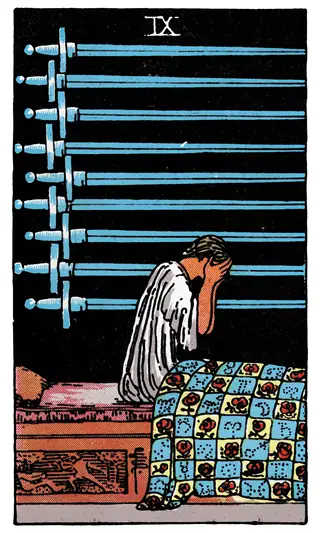
The Nine of Swords represents worry, restless nights and the strain of replaying a difficult thought. Its tarot card meaning concerns the experience of fear, rather than proof that a feared event will happen. In the Rider–Waite–Smith image, a person sits up in bed with their face covered while nine swords hang behind them. None touches the figure. This distinction matters: distress is real, but the story attached to it may still be uncertain. Read the card alongside your question and the facts you have. It can invite an honest conversation, a clearer boundary or a pause before deciding. Unlike the Eight of Swords, which emphasizes feeling restricted, this card brings attention to the private burden of anticipation.
Nine of Swords Upright Meaning
Worry is taking up more space than the facts currently justify.
Upright, this card describes the moment when thinking stops producing useful information and starts repeating the same alarm. You might rehearse an uncomfortable conversation, return to a mistake that others have already moved past, or imagine several bad endings to a situation that remains open. The reading asks what is known, what is assumed, and which part of the question can actually be answered today.
Look closely at the image. The seated figure covers their eyes, so their attention is turned inward. The horizontal blades form a dark backdrop rather than an attack. The patterned blanket places roses and small symbols beside the distressing scene; one possible reading is that ordinary care and comfort remain present, even when worry obscures them. These are interpretive associations, not a code with one compulsory answer.
Compare the Eight of Swords: its bound, blindfolded figure suggests restricted options or a belief that no safe move exists. Here, the emphasis shifts from being unable to move to being unable to stop thinking. Neither image establishes whether an outside problem is serious. Their difference helps you ask a better question: do you need more options, or a more reliable way to assess the options you already have?
In everyday life, this might resemble waking with the same unfinished thought, preparing for rejection before anyone has responded, or treating another person’s mood as your responsibility. Try describing the concern without explaining it away: “I have not heard back” is an observation; “I have ruined everything” is a conclusion. The useful next step comes from the observation. A card cannot promise that all is well, but it can remind you to check before treating a possibility as a certainty.
Nine of Swords Reversed Meaning
Pressure may be easing, or the worry may be harder to acknowledge.
Reversed does not automatically mean a happy ending or a stronger warning. Two readings are especially useful here: you are beginning to loosen a painful thought pattern, or you are keeping the worry out of sight. Choose between them by considering your experience, rather than drawing again until a preferred interpretation appears. Both readings may fit at different moments.
When the pressure begins to lift
The first possibility is a small return of perspective. Perhaps you can name the concern without immediately defending it, ask a question you have avoided, or accept that one difficult evening does not describe your whole future. Relief may arrive as an ordinary action: replying to a message, admitting uncertainty, or letting someone know that you would welcome company. The point is movement, not a sudden transformation.
In this reading, a reversal marks an opening. Something that felt completely private can be shared; a fixed conclusion can become a question again. Notice what helped and what remains unresolved. Feeling lighter does not require you to claim that the problem has disappeared, and having another difficult day does not invalidate the progress you noticed.
A practical reflection is to write the concern as one specific sentence, identify what would give you useful information, and choose one manageable action. “I worry about the meeting” is easier to work with than “everything is falling apart.” You might ask for the agenda or clarify what is expected. Leave the rest of the situation open rather than demanding total reassurance from one step.
When worry stays out of sight
The other possibility is concealment. You may sound composed while avoiding the conversation that matters, fill every available moment so you do not have to sit with uncertainty, or say that nothing is wrong because explaining it feels too difficult. This reading is relevant only if you recognize the pattern yourself.
Ask whether your current approach creates room to respond, or simply postpones the same question. A full calendar can be enjoyable and useful. It becomes relevant to this reading only if you recognize that you are using it to avoid something you want to address.
An honest first step may be a modest statement such as “I do not have an answer yet, but this has been on my mind.” Choose someone you trust, or put the thought on paper privately if that feels more comfortable. You do not have to explain or solve everything at once.
Which reading fits your situation?
Consider three questions: can you describe the worry more clearly than before? Have you gained new information, or only become better at avoiding the subject? If the immediate issue were resolved, what would still need your attention? These questions are reflection prompts, not a scored assessment. Mixed answers are a reason to stay curious, rather than force yourself into one branch.
Nine of Swords Reversed in Love
In a relationship reading, the reversal can suggest opening a difficult conversation or continuing to hide an insecurity. The difference is visible in what you communicate, not in what you imagine your partner feels. Try naming a need without assigning a motive: “I would like us to make time to talk” leaves more room than “you clearly do not care.” Another person’s response remains theirs to give.
Nine of Swords Yes or No
Usually no, or not yet: pause when fear is driving the decision.
For a simple tarot reading, the usual answer is no or not yet. This is an interpretive convention, not a forecast of failure. The card draws attention to the state in which you are deciding. A question shaped by worry may need clarification before a yes-or-no answer is useful.
For love questions such as “will they return?”, the card cannot report another person’s intentions. It can describe the cost of waiting and guessing. Distinguish a message you have actually received from a conversation you have only imagined. Decide what information or boundary would help you move forward, whether or not the other person responds.
For a work question, separate the task from the fear attached to it. “Is this role right for me?” is different from “what if everyone thinks I failed?” A card cannot decide an application or resignation for you. Review the practical facts before making a consequential choice.
If your question is whether to ask for support, clarify an expectation or take a break from repeated readings, a constructive yes can fit. That does not contradict the usual no: the question has changed. The purpose is a more grounded next step, not a guarantee about the outcome.
Nine of Swords in Love & Relationships
Separate what the relationship shows you from what uncertainty makes you imagine.
With a partner, this card can reflect worry that has not become a conversation. You may revisit a short reply or assume responsibility for a change in someone’s mood. Begin with the specific moment and ask what it meant. Making a need explicit gives both people something to respond to; silently testing whether they notice creates another uncertainty. If there is a real pattern of broken trust, look at that evidence rather than dismissing every concern as overthinking.
When single, the image can describe anticipating the pain of a relationship before one has begun. Past experiences may influence what you expect, but they do not tell you everything about a new person. Ask what you know from current behavior and what you are carrying forward from a previous connection. You can move slowly, keep your boundaries and remain open without promising yourself that nobody will disappoint you.
After a breakup, repeatedly reviewing old conversations can feel like a search for a final explanation. Sometimes useful information has already been gathered and the review simply reopens the same question. Consider what you need now, separately from whether you will ever understand every detail. This card cannot confirm reconciliation, blame or another person’s hidden feelings. Its value is in helping you notice how much attention the unanswered question is consuming.
Nine of Swords in Career & Money
Turn a vague professional or financial worry into a question you can check.
At work, this can be the difference between preparing for a meeting and repeatedly imagining that it will go badly. Preparation produces something usable: notes, a question, a finished task. Rehearsing an imagined judgment often produces no new information. Check which activity you are doing before giving it another hour. If expectations are unclear, asking for clarification may be more useful than preparing for every possible version of the task.
With money, worry may concern a genuine practical difficulty. Do not interpret the card as proof that the difficulty is imaginary, or as a promise that a bill will resolve itself. Gather the relevant figures and identify what needs an answer first. As general advice, focus on one concrete unknown you can clarify instead of trying to settle your entire future in a single reading.
Compare related cards
- Eight of Swords: Nine of Swords centers worry and sleeplessness; Eight of Swords turns toward restriction and perspective. Feeling trapped may reflect limiting beliefs as well as real constraints; examine the options carefully.
- Ten of Swords: Nine of Swords centers worry and sleeplessness; Ten of Swords turns toward ending and exhaustion. A painful chapter has reached its limit; acknowledge the ending before considering what comes next.
Frequently asked questions
What does the Nine of Swords mean for feelings?
It can symbolize worry, guilt or feeling emotionally overwhelmed. In a reading about someone else, that is an interpretation of a card, not access to their thoughts. Look at what the person has communicated and how they behave before deciding what they feel about you or the relationship.
Is the Nine of Swords a yes or a no?
It is commonly read as no or not yet, especially when fear is driving the question. It does not guarantee an unwanted outcome. For a question about seeking support or clarifying a situation, a constructive yes may be more appropriate; the wording and context of the question matter.
What should I do when I draw the Nine of Swords?
Separate an observation from a feared conclusion, then consider one useful question or conversation. You do not need repeated draws to earn a reassuring result. If worry or disrupted sleep is persistent or affecting daily life, consider speaking with a qualified professional; a tarot reading cannot diagnose or treat it.
What is the spiritual meaning of the Nine of Swords?
One reflective interpretation is learning to notice a thought without treating it as a complete account of reality. The image can invite honesty and compassion rather than self-punishment. This is a meaning you may choose to explore, not a supernatural explanation for suffering or a claim that you caused it.